Monday, November 4, 2013
The Bluest Eye 3/3
The family dynamics here are twisted in a way that the student essays, especially the Asian-American ones that focused on sexuality, weren't. In those households where homosexuality was considered a perversion and sin, I don't feel that incest and rape would be as much of a concern (although I certainly don't know for sure). The way that the justification of the sexual abuse of those little girls described their reactions as being "the light white laughter of little girls," how it uses white as if that adjective forgives or at least ameliorates the consequences of the context stood out and surprised me (Morrison 181). The way that the reactions to Pecola's pregnancy centered on how the baby would "be the ugliest thing walking" was also shocking and saddening (189). As opposed to focusing on the fact that Cholly impregnated his daughter, they focus on how they want the baby dead, and they eventually get their wish.

Thursday, October 31, 2013
Discussion
Firstly, there's a little bit of follow-up from Tuesday's discussion that I'd like to touch upon relating to the concepts of beauty.
After that, I have a personal few questions that I want to ask; you won't have to share your answers, but I hope you'll keep what you've written down and refer back to it on occasion if your answers are honest. A few of the questions are adapted from some advice that one of my high school teachers gave us. The rest are what I came up with and what I've been asking myself.
I have a couple of short video segments that I'd like to show (although one of them may have inappropriate language) that can help relate the issues seen in The Bluest Eye to our own times, because although the time and setting have changed, the same issues plague our society. I'm hoping this will all help launch and push on the discussion.
After that, I have a personal few questions that I want to ask; you won't have to share your answers, but I hope you'll keep what you've written down and refer back to it on occasion if your answers are honest. A few of the questions are adapted from some advice that one of my high school teachers gave us. The rest are what I came up with and what I've been asking myself.
I have a couple of short video segments that I'd like to show (although one of them may have inappropriate language) that can help relate the issues seen in The Bluest Eye to our own times, because although the time and setting have changed, the same issues plague our society. I'm hoping this will all help launch and push on the discussion.
Wednesday, October 30, 2013
The Bluest Eye 2/3
One of the things that stood out to me the most in the beginning of this section (and sent a chill up my spine) was the description of how some "particular brown girls" grew up and lived life -- how they learned "how to behave" (Morrison 82, 83). The idea of a kind of person being created by this society, a kind of person that thinks they have "to get rid of the funkiness" of "passion," "nature,"the funkiness of the wide range of human emotions" (83). The idea is a little terrifying and very sad to me, because in my opinion feelings emotions is one of the best things about being alive.
The innocence (however misplaced or misguided) that Claudia maintains even while being confronted with the news of Frieda's sexual assault is at such odds with the rest of the characters. She's "jealous of everything" in the childish way of not wanting to be left out, even saying, "I always miss stuff," when hearing about the commotion afterwards (100). The gravity of the situation doesn't truly hit her, but she still does her best to try to help Frieda; she tries suggesting ways for Frieda to maintain her state of being 'not ruined.' The way that she remains relatively untouched by the fear and horror surrounding her is touching in a way, when everybody (especially Pecola) is worn down by the world they live in. Pauline taught her children the fears of "being clumsy," "being like their father," "not being loved by God," and so on, and that sort of family environment for children growing up is possibly one of the worst that I can think of (and indeed, what Morrison was attempting to convey, going by her foreword) (128).
The innocence (however misplaced or misguided) that Claudia maintains even while being confronted with the news of Frieda's sexual assault is at such odds with the rest of the characters. She's "jealous of everything" in the childish way of not wanting to be left out, even saying, "I always miss stuff," when hearing about the commotion afterwards (100). The gravity of the situation doesn't truly hit her, but she still does her best to try to help Frieda; she tries suggesting ways for Frieda to maintain her state of being 'not ruined.' The way that she remains relatively untouched by the fear and horror surrounding her is touching in a way, when everybody (especially Pecola) is worn down by the world they live in. Pauline taught her children the fears of "being clumsy," "being like their father," "not being loved by God," and so on, and that sort of family environment for children growing up is possibly one of the worst that I can think of (and indeed, what Morrison was attempting to convey, going by her foreword) (128).
Monday, October 28, 2013
The Bluest Eye (1/3)
In the foreword of this novel, Morrison describes how she tried to show how "the death of self-esteem can occur quickly, easily in children" (Morrison x). From her perspective, a young black girl would be "the one least likely to withstand such damaging forces" of a relentless, despair-driven society, and so Pecola became the protagonist of this story.

From the beginning of this novel, the societal circumstances of the Breedlove family are part of what brings Pecola down. One description of their house in particular stood out to me: "The furniture has aged without ever having become familiar" (35). The simple way that it describes years of existing in the house but not actually becoming meaningful or important was very piercing. The "joylessness" of living like that "stank, pervading everything" similarly to how the "ugliness" became a part of the Breedloves themselves (36, 39). The way that they embrace their so-called ugliness and incorporate it into their own sense of self and being is striking in how it truly begins to define them all; Pecola becomes "a little black girl" that a man "need not waste the effort of a glance" to look upon, not "desirable or necessary" at all (48). To top it off Pecola doesn't feel outraged or wronged by such treatment; she accepts it even while it upsets her and makes her feel ugly and want to cry. In contrast, the "whores in whores' clothing" seem to be the only characters enjoying themselves and their places in life (57). "Three merry gargoyles" "dissolved in laughter" while discussing their whoredom and didn't care (55). This sort of reversal of self-images between a young girl and a whore and how comfortable and accepting they are in their own shoes is shocking. The "fear of ugliness than enables more readers to identify with this basic situation of racism" that is seen throughout this book is possibly the easiest way that we as readers can relate to the situations described in the book (Bump 607). So far there have been certain phrases in the prose that have struck true with me, and hopefully there will be more yet to come.
Bringing the topic a little closer to home, the anthology speaks a great deal about the racial history of UT. I had no idea that one of the dorms was named after the man "who organized the Ku Klux Klan in Florida after the Civil War," nor that MLK "spent the night in a little apartment on the top floor of the Texas Union" (anthology 584, 587). Such facts are much healthier aspects of UT's racial history than the multitude of pro-Confederate statues out on our lawns. There are many things that we as a campus as well as we as people ourselves can fix in terms of our responses towards racial identity and how we confront racial history. This is one of the ways that we can move forward.
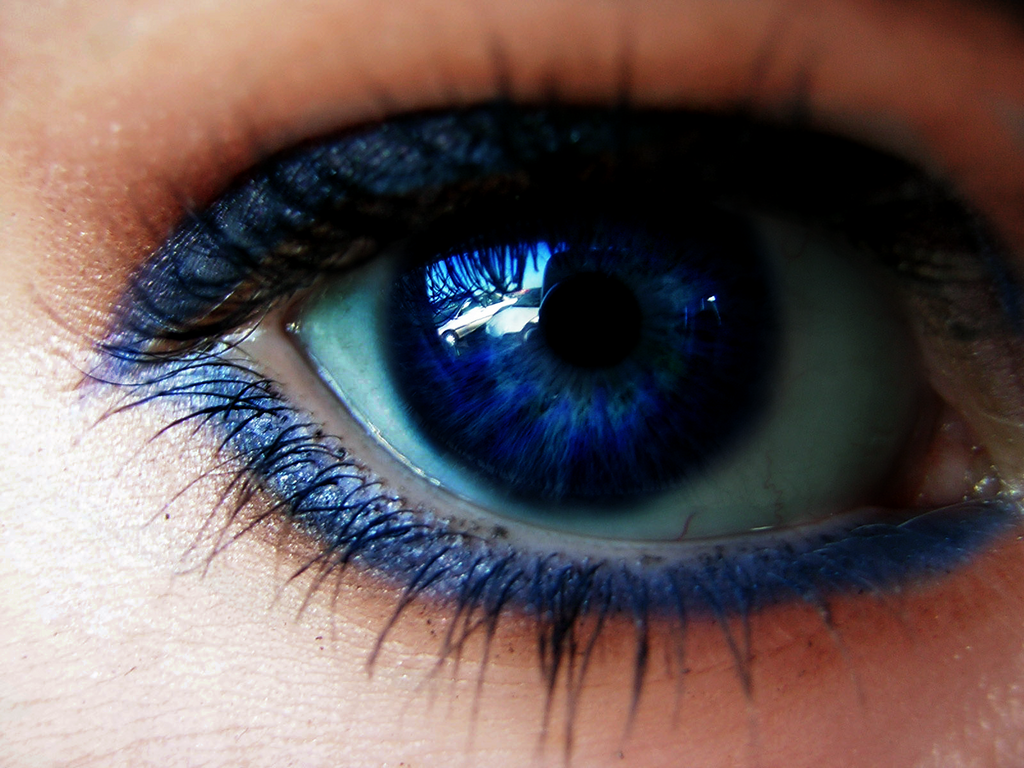
From the beginning of this novel, the societal circumstances of the Breedlove family are part of what brings Pecola down. One description of their house in particular stood out to me: "The furniture has aged without ever having become familiar" (35). The simple way that it describes years of existing in the house but not actually becoming meaningful or important was very piercing. The "joylessness" of living like that "stank, pervading everything" similarly to how the "ugliness" became a part of the Breedloves themselves (36, 39). The way that they embrace their so-called ugliness and incorporate it into their own sense of self and being is striking in how it truly begins to define them all; Pecola becomes "a little black girl" that a man "need not waste the effort of a glance" to look upon, not "desirable or necessary" at all (48). To top it off Pecola doesn't feel outraged or wronged by such treatment; she accepts it even while it upsets her and makes her feel ugly and want to cry. In contrast, the "whores in whores' clothing" seem to be the only characters enjoying themselves and their places in life (57). "Three merry gargoyles" "dissolved in laughter" while discussing their whoredom and didn't care (55). This sort of reversal of self-images between a young girl and a whore and how comfortable and accepting they are in their own shoes is shocking. The "fear of ugliness than enables more readers to identify with this basic situation of racism" that is seen throughout this book is possibly the easiest way that we as readers can relate to the situations described in the book (Bump 607). So far there have been certain phrases in the prose that have struck true with me, and hopefully there will be more yet to come.
Bringing the topic a little closer to home, the anthology speaks a great deal about the racial history of UT. I had no idea that one of the dorms was named after the man "who organized the Ku Klux Klan in Florida after the Civil War," nor that MLK "spent the night in a little apartment on the top floor of the Texas Union" (anthology 584, 587). Such facts are much healthier aspects of UT's racial history than the multitude of pro-Confederate statues out on our lawns. There are many things that we as a campus as well as we as people ourselves can fix in terms of our responses towards racial identity and how we confront racial history. This is one of the ways that we can move forward.
Wednesday, October 23, 2013
Asian-American Essays (read: on being indian-american and semi-secretly bisexual)
I thought that I would be a little bit more able to relate to these essays than the previous ones we had read, but it turns out that the subject matter in these essays struck a little further from home purely based on the descriptions of the authors' family lives.
The first essay discussed how hard it was to come to terms with being biracial and finding out where exactly to belong, and while I'm not biracial, I feel the same sort of confusion when I visit India. For a long time when I was younger, I was determined to not give up being Indian, as if embracing the American culture that surrounded me would somehow erase that part of me completely. When people asked where I was from, I would tell them India even though I knew they meant where do you live. Excessive use of italics aside, I was (and am) a stubborn kid, and even now my fingers want to type 'when I visit home' instead of 'when I visit India.' When I do go back, the culture clash is very obvious. Apart from the heritage and language barrier that I talked about in class yesterday, it's evident even in casual conversation. My cousins, all a few years older than me, all talk about the latest movies they've seen and the latest kind of clothes out there (I didn't even know designer saris existed before this summer). As Anthony said, "I don't look the part that's played me." I look like I should fit in with them perfectly, especially when my aunts have dolled me up in a beautiful borrowed sari and hastily-fitted blouse, but I actually have no basis to relate to them with. I haven't found the blend of cultures that will work for me yet, but I'm working on it.

The other essays dealt with exploring and discovering sexuality and ultimately the authors' families' reactions towards their coming out. This is the part that I can't really relate to, not because I'm heterosexual (I'm not), but because I haven't officially come out to my parents and because (as far as I can tell) my parents do not disapprove or abhor homosexuality.
In actuality, I've only officially toldseven nine people (my closest friends and people that I can trust) explicitly that I am bisexual, although I'm sure there are a couple more who suspect something. Apart from the people that I've told with my own mouth, the only others that know are you guys, if any of you clicked on the previous blog entry or if you're reading this right now. It's not necessarily a secret of mine, but I guess it's just like the rest of my personality; I don't broadcast my preferences, whether they are related to music or hobbies or sexuality. (If you are reading this right now, then I guess I have to update my count.)
There were a couple of things that stood out in the other essays; one phrase in particular from Johnny Lee's essay was how he "didn't have to alter the pronouns I used when referring to people [he] was attracted to." It may seem like a little thing, but to have the general response surrounding such questions always be using gender-based pronouns. It was always "Are there any guys you like?" to me, and after finally coming to terms with myself I felt so stifled and smothered. I wanted to respond with something like "No, but what if there were some girls?" when I was asked, but I was far too cautious to respond. I'd respond with gender-neutral answers when people asked me what I looked for -- yes, in a guy. My replies were always along the lines of "Oh, they...." or "Yeah, I think I like people who...", although I don't think anyone picked up on it.
The reason that I can't really relate (yet?) to the majority of the second essays is because in both cases, the families involved were vehemently, vocally disapproving of being gay. For my part, my parents are very liberal and open with me (for the most part). We watch The Colbert Report together and we talk about almost everything that happens in my life, and from what I've seen so far I can draw the tentative conclusion that they don't find homosexuality repulsive as some do. I'm sure they've suspected on occasion because I'm very opinionated about certain issues, but I've never told them anything explicitly. (It hasn't stopped my mom from asking whether I was going to bring a guy -- or a girl -- home at any point. For the record, I didn't answer.) Where I am currently, my sexuality isn't really a secret, but since heterosexuality is assumed until proven otherwise, it may well be a shock to anyone who figures out.
Cheers.
The first essay discussed how hard it was to come to terms with being biracial and finding out where exactly to belong, and while I'm not biracial, I feel the same sort of confusion when I visit India. For a long time when I was younger, I was determined to not give up being Indian, as if embracing the American culture that surrounded me would somehow erase that part of me completely. When people asked where I was from, I would tell them India even though I knew they meant where do you live. Excessive use of italics aside, I was (and am) a stubborn kid, and even now my fingers want to type 'when I visit home' instead of 'when I visit India.' When I do go back, the culture clash is very obvious. Apart from the heritage and language barrier that I talked about in class yesterday, it's evident even in casual conversation. My cousins, all a few years older than me, all talk about the latest movies they've seen and the latest kind of clothes out there (I didn't even know designer saris existed before this summer). As Anthony said, "I don't look the part that's played me." I look like I should fit in with them perfectly, especially when my aunts have dolled me up in a beautiful borrowed sari and hastily-fitted blouse, but I actually have no basis to relate to them with. I haven't found the blend of cultures that will work for me yet, but I'm working on it.
The other essays dealt with exploring and discovering sexuality and ultimately the authors' families' reactions towards their coming out. This is the part that I can't really relate to, not because I'm heterosexual (I'm not), but because I haven't officially come out to my parents and because (as far as I can tell) my parents do not disapprove or abhor homosexuality.
In actuality, I've only officially told
There were a couple of things that stood out in the other essays; one phrase in particular from Johnny Lee's essay was how he "didn't have to alter the pronouns I used when referring to people [he] was attracted to." It may seem like a little thing, but to have the general response surrounding such questions always be using gender-based pronouns. It was always "Are there any guys you like?" to me, and after finally coming to terms with myself I felt so stifled and smothered. I wanted to respond with something like "No, but what if there were some girls?" when I was asked, but I was far too cautious to respond. I'd respond with gender-neutral answers when people asked me what I looked for -- yes, in a guy. My replies were always along the lines of "Oh, they...." or "Yeah, I think I like people who...", although I don't think anyone picked up on it.
The reason that I can't really relate (yet?) to the majority of the second essays is because in both cases, the families involved were vehemently, vocally disapproving of being gay. For my part, my parents are very liberal and open with me (for the most part). We watch The Colbert Report together and we talk about almost everything that happens in my life, and from what I've seen so far I can draw the tentative conclusion that they don't find homosexuality repulsive as some do. I'm sure they've suspected on occasion because I'm very opinionated about certain issues, but I've never told them anything explicitly. (It hasn't stopped my mom from asking whether I was going to bring a guy -- or a girl -- home at any point. For the record, I didn't answer.) Where I am currently, my sexuality isn't really a secret, but since heterosexuality is assumed until proven otherwise, it may well be a shock to anyone who figures out.
Cheers.
Monday, October 21, 2013
Hispanic-American Essays
If I had to sum up Miguel's essay in one phrase, it would be "not being ____ enough." Whether that blank is filled with 'Mexican' or 'gay' or any other quality, that's the main feeling I got from his essay, and it's sad that it's so easy to relate to. The idea that we all have to fit into our labeled, little prescribed boxes to appease society is frustrating and disappointing, but it's ultimately something that we can't escape no matter who we are. People looking at Migeul would think first 'gay Mexican Dartmouth student.' People looking at me would think 'Indian girl in computer science,' mostly because I'm not quite so open as Miguel about my other attributes that would be quickly added as more labels on my person. The matter-of-fact way that Miguel seems to have written this essay just seems to highlight the way that he has accepted his lot in life, and that more than anything is admirable.
Not being "'gay enough' for the gay students," having "people know that I am American" "before I even say a word..." I can relate to these experiences on both counts. I've heard that bisexual people sometimes receive a stigma even from the LGBT community for not being gay enough, for being wishy-washy or indecisive, for not being brave enough to 'come out completely.' When I go to India and go shopping, I'm not allowed to talk in stores -- the fact that I don't speak Hindi or Kannada (neither of which are my mother-tongue) and my accent in general tip store owners off immediately, and subsequently prices get doubled (sometimes even tripled). The fact that I can relate is sad, but it is true.

Alessandro's essay was also very interesting in terms of how he 'compartmentalized' the parts of his heritage. "Speaking Spanish at home" even after "[spending] most of the day in the English-speaking world" helped keep him in touch with his heritage, and I miss that in my own life. I personally do not speak my native language, Konkani, but I understand it fluently to the point that there isn't even a delay between hearing it and understanding it -- understanding it is innate to me, but I'm just so out of practice with forming it that I can't speak it.
Going to India this summer, the first time in a few years that I've done so, and meeting up with all of my relatives reminded me very clearly of this gap. In my extended family from my mother's side, there are two of us who have left India; my mother's family (her, my father, and me) and one of my aunt's (her, her husband, and her daughter). My cousin and I are 'those two foreign ones' when we go back to India, American for me and Canadian for her. Unlike me, however, my cousin is still in the habit of speaking Konkani, so the visit went fine for her. I, on the other hand, ended up with somebody next to me all the time in order to respond to my relatives' comments. It was a very sobering experience to feel that isolated within my own people -- my own family, even.

Not being "'gay enough' for the gay students," having "people know that I am American" "before I even say a word..." I can relate to these experiences on both counts. I've heard that bisexual people sometimes receive a stigma even from the LGBT community for not being gay enough, for being wishy-washy or indecisive, for not being brave enough to 'come out completely.' When I go to India and go shopping, I'm not allowed to talk in stores -- the fact that I don't speak Hindi or Kannada (neither of which are my mother-tongue) and my accent in general tip store owners off immediately, and subsequently prices get doubled (sometimes even tripled). The fact that I can relate is sad, but it is true.
---
Going to India this summer, the first time in a few years that I've done so, and meeting up with all of my relatives reminded me very clearly of this gap. In my extended family from my mother's side, there are two of us who have left India; my mother's family (her, my father, and me) and one of my aunt's (her, her husband, and her daughter). My cousin and I are 'those two foreign ones' when we go back to India, American for me and Canadian for her. Unlike me, however, my cousin is still in the habit of speaking Konkani, so the visit went fine for her. I, on the other hand, ended up with somebody next to me all the time in order to respond to my relatives' comments. It was a very sobering experience to feel that isolated within my own people -- my own family, even.

Monday, October 14, 2013
Black Elk Speaks
Black Elk Speaks was a very interesting take on a different perspective from what we usually see. Even from just the introduction explaining what kind of work it is we're able to see how different it is - it is an example of spoken story-telling rather than something explicitly meant to be passed down through writing. Imagining this sort of tradition helps set the tone of this work, especially the idea presented in the very beginning of the scope of the story. The speaker saying that "if it were only the story of my life I think I would not tell it," but he will say it since "it is the story of all life that is holy and good to tell." Going further, the story is described as being of "children of one mother and their father is one Spirit," emphasizing the universal applicability of this story.

Although the story of the great vision was fascinating, the aftermath was easier to relate to, especially where Black Elk says "I was afraid to tell, because I knew that nobody would believe me, little as I was, for I was only nine years old." I myself have not experienced any similar vision that told me of a higher purpose that I am to serve (why am I really here?), but the feeling of not being taken seriously because of your age is
familiar.

The conflict that Black Elk felt when wondering if his vision had been real or not (convincing himself that it had been, and then that it hadn't again and again) was also more familiar to me than the experience of the vision itself. I think a great deal and I certainly over-think some decisions (to the point where I get fed up of myself), and when I read the section about Black Elk planning to shoot, I felt that I could understand the conflict. Similarly to Vizenor in Squirrel, Black Elk ended up shooting the frog and then regretting it immensely because of the connection he felt to it, and that conflict in the aftermath was saddening.

The sort of mindset involved with deciding what is worth passing on.
Although the story of the great vision was fascinating, the aftermath was easier to relate to, especially where Black Elk says "I was afraid to tell, because I knew that nobody would believe me, little as I was, for I was only nine years old." I myself have not experienced any similar vision that told me of a higher purpose that I am to serve (why am I really here?), but the feeling of not being taken seriously because of your age is
familiar.
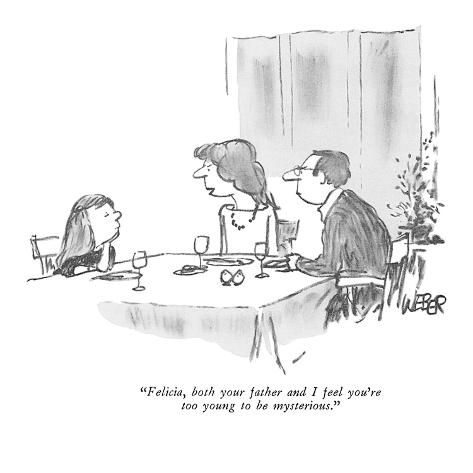
Really?
The conflict that Black Elk felt when wondering if his vision had been real or not (convincing himself that it had been, and then that it hadn't again and again) was also more familiar to me than the experience of the vision itself. I think a great deal and I certainly over-think some decisions (to the point where I get fed up of myself), and when I read the section about Black Elk planning to shoot, I felt that I could understand the conflict. Similarly to Vizenor in Squirrel, Black Elk ended up shooting the frog and then regretting it immensely because of the connection he felt to it, and that conflict in the aftermath was saddening.
Subscribe to:
Posts (Atom)